

International freight transport
International freight transport covers carriage from Lithuania to other European countries and back. We organise the route, the vehicle and the required documents so that the transport is planned clearly and the transit time is assessed according to the specific destination.

International freight transport in brief
trans.lt is the freight transport website of UAB „Kauno logistikos agentūra“. Since 2001 we have been organising international freight transport from Lithuania to European countries and back. We handle full, part, dangerous and special-condition loads, and for each destination we select a transport solution according to the nature of the cargo, the deadline, the documents and the specifics of the route.
We work both with European Union countries and with destinations outside the EU, so we tailor a separate solution for each destination. On this page you will find the destinations served by our international transport and links to each country’s page with more detailed information.

What is international freight transport?
International freight transport means carrying cargo across the borders of one or more countries. Depending on the destination, transport documents and road use, traffic or customs requirements may differ. International shipments travel on different routes – some directly, others with transhipment at the border. Depending on the destination, the journey may be longer or shorter. When cargo has to cross several countries in succession, we plan the route so that there are as few stops and transhipments as possible.
Destinations we ship to
Freight transport in Europe today covers dozens of destinations – from the neighbouring Baltic states to more distant Southern Europe. International transport runs to European countries and to destinations outside the European Union. On each destination page you will find transit times, documents and requirements specific to that country.

Northern Europe
These destinations are most often chosen by clients who value a stable schedule and the combination of a ferry leg with road transport.
- Sweden
- Norway
- Denmark
- Finland

Western Europe
Thanks to the frequent flow of freight on these routes, part loads are easier to combine and a suitable vehicle is usually found faster.
- Germany
- France
- Belgium
- the Netherlands
- Ireland
- Switzerland
- Austria
- United Kingdom (England)

Southern Europe and Turkey
A longer distance means a longer transit time, so we plan routes to these destinations with a time buffer.

Central and Eastern Europe
These destinations are often combined with longer routes to Southern Europe or the Balkans, so shipments may travel together with other cargo.
- Poland
- Czech Republic
- Slovakia
- Hungary
- Slovenia
- Croatia
- Romania
- Bulgaria

Baltic states and Eastern destinations
Latvia and Estonia are EU countries, so customs declarations are usually not required. When shipping to Ukraine and Moldova, we additionally assess customs and documentation requirements, which differ from intra-EU transport.
- Latvia
- Estonia
- Ukraine
- Moldova
If the destination you are looking for is not on the list, contact us. International freight transport to new destinations is nothing new for us – we expand our route network when needed.
What cargo is suitable for international transport?
On international routes we carry standard palletised cargo as well as larger or irregularly shaped cargo. Depending on the nature of the cargo, we select a suitable trailer – box, curtain-side or specialised. If the cargo requires temperature control or falls into the dangerous goods category, we take this into account as early as the planning stage. You can read more about carrying dangerous goods on our dangerous goods transport page.

What should you know before shipping cargo to another country?
Before sending a request, check a few things – this will help us prepare an accurate quote faster. Assess the weight, dimensions and packaging of the cargo, as these determine which vehicle is suitable. Check whether the destination country is in the European Union – this affects the number of documents. If the transport will be repeated regularly, let us know straight away – we may be able to offer an agreed schedule for regular routes. If the cargo value is higher, it is worth assessing in advance whether the carrier’s liability limits would be sufficient and whether additional cargo insurance is needed for the specific transport.


How do we organise international transport?
For every international shipment we select the most suitable transport solution. We assess the cargo size, deadline and route. Depending on your needs, we offer full truckload (FTL) or part-load (LTL) transport. When choosing a route, we take into account border crossing points, traffic restrictions and the usual number of stops on the specific route. You can read more about transport types and their advantages on our transport services page.
For more distant destinations, where cargo requires several modes of transport, we organise combined (multimodal) transport. Such international freight transport involves several modes of transport – part of the journey is covered by road and part by ferry. We usually choose this solution for destinations that are difficult or too time-consuming to reach by road alone.
For regular clients whose shipments move in the same direction, we can agree a recurring schedule or a pre-planned range of loading dates. This allows loading dates to be planned in advance and reduces waiting time between shipments. For irregular, one-off shipments, we build the route around the specific deadline the client needs.

Customs formalities in international transport
When transporting goods between European Union countries, additional customs formalities are usually not required. When crossing the EU border, for example when shipping to the United Kingdom, Ukraine, Turkey, Switzerland or Norway, additional documents may be needed. We help assess in advance what information will be required and coordinate the preparation of documents with the client and customs brokers to reduce the risk of delays at the border. You can read more about customs brokerage on our customs formalities page.

How long does international freight transport take?
The transit time depends on the distance, the destination and the number of border crossings. One international shipment may take a few days, another a week or longer, depending on the destination. The time of year also affects the transit time – in winter, traffic conditions on some routes are more difficult, so we take this into account when planning the route. We state an estimated transit time in the quote after assessing the data of the specific cargo.

Cargo insurance on international routes
In international road transport, the carrier’s liability for the cargo is usually limited under the CMR Convention. This is not the same as full insurance of the cargo’s value. If the cargo value is high, the cargo is fragile or hard to replace, or the route is more complex, we can help arrange additional cargo insurance.
Additional cargo insurance is arranged separately for the specific cargo and the specific transport. Its terms, insurer, territorial validity, exclusions and coverage limits are set out in the specific insurance policy.
For some destinations or territories, insurance cover may be restricted. When shipping to or from Ukraine, we separately check the territorial validity of the carrier’s liability insurance and war risk exclusions before confirming the transport. Additional cargo insurance for this destination is also agreed individually, depending on the specific cargo and the insurer’s terms.
You can read more about carrier’s liability insurance and additional cargo insurance on our cargo insurance page.


Why choose us for international freight transport?
We work with the customs requirements of different countries and know where delays most often occur along the route. International freight transport requires constantly updated knowledge of the specifics of each destination, so we follow changes in every country we ship to. We apply this knowledge when planning the cargo’s route. For us, international freight transport is not a one-off service – it is daily work with different destinations. You can read more about our experience and working principles on our logistics services page.

How does cargo travel through several countries?
On longer international routes, cargo may cross one or several transit countries. When planning such a route, we assess the transit countries, road and traffic restrictions, driving and rest times and, where applicable, border or customs procedures. Before dispatching the vehicle, we check which traffic restrictions may apply in the countries along the route – some countries impose driving bans on heavy vehicles at weekends or on public holidays, so we include this factor in the overall transit time calculation.
The driver must comply with driving and rest time requirements: common driving and rest time rules apply in the European Union. For longer routes, this means at least one longer rest stop is planned along the way. For more distant destinations, an additional driver or a different work arrangement may be considered so that the transit time is planned realistically in line with driving and rest time requirements. We assess these details when planning the route, not once the cargo is on the road.
Border crossing and waiting time
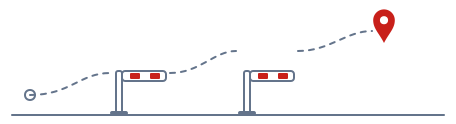
Even within the European Union, traffic congestion sometimes builds up at borders or on the main transit corridors, especially during busier seasons or before holidays. When shipping to countries outside the European Union, customs inspections add to the waiting time, and their duration may vary depending on the specific border crossing and the time of day. In such cases we choose less congested border crossings if this shortens the overall journey time.
If we receive information about a customs inspection or a possible delay, we inform the client as soon as possible so that they can plan their next steps accordingly. This way the client knows the real situation on the road and can plan their further actions, for example by notifying their buyer of a possible change in delivery.

Cargo tracking on an international route
When cargo travels through several countries, the client needs to know not only the overall transit time but also the specific stage the cargo is currently at. The responsible contact assigned to the transport stays in touch with the driver or carrier and reports on the main stages: loading, border crossing where relevant, and the estimated time of arrival. During working hours the client can contact us and check on the status of the cargo.
This is particularly important when the client’s further business processes in another country depend on the delivery time, for example receiving goods at a warehouse or handing them over to the end buyer. Knowing a more precise arrival time in advance, the client can plan these steps instead of facing surprises.

Contact us for a quote
Do you have cargo that needs to be transported to another country? Write to us at [email protected], call +370 37 454255 or fill in the request form – we will assess the destination and cargo details and send you a quote with the price and an estimated transit time.
FAQ
Who provides international freight transport services from Lithuania?
Through trans.lt, UAB „Kauno logistikos agentūra“ organises international freight transport from Lithuania to European countries and back. The company handles full, part and special-condition loads.
Which countries do you ship to?
We ship to most European countries: Scandinavia and Finland, Germany, France, the Benelux countries, the United Kingdom, Spain, Italy, Poland, the Czech Republic and other Central European countries, the Baltic states, as well as Turkey and Ukraine. You will find all destinations in the list of destinations on this page.
Does trans.lt organise freight transport to EU and non-EU countries?
Yes. trans.lt / UAB „Kauno logistikos agentūra“ organises transport both within the European Union and to destinations outside the EU, where additional customs documents may be required.
What information should an international transport request include?
It is useful to state the loading and unloading locations, the description of the goods, weight, dimensions, packaging, cargo value, readiness date and whether insurance or customs formalities will be needed.
How long does it take to transport cargo to another country?
The duration depends on the distance and destination. We provide an estimated transit time together with the quote after assessing the data of the specific cargo.
Are special documents needed for international cargo?
It depends on the destination. Within the European Union, customs formalities are usually not required, but the cargo must be accompanied by the usual transport and goods documents. When shipping outside the EU, additional customs documents may be needed, and we help coordinate their preparation with the client and customs brokers.
Do you carry part loads on international routes?
Yes. Part load (LTL) is suitable for smaller quantities when a full truck is not needed. You can read more about this on our part-load transport page.
How much does international freight transport cost?
The price depends on the destination, the cargo size and the chosen transport solution. We provide the exact price in an individual quote.
Can I find out where my cargo is right now?
Yes. We assign a responsible contact to every transport, who keeps you informed about the movement of the cargo. You can read more about communication on our logistics services page.
What vehicles do you use for international cargo?
Depending on the destination and the nature of the cargo, we use road transport or combine it with a ferry leg. We tailor the solution to the specific journey rather than a standard scheme.
Do you organise transport to a country that is not on the list?
If the country you need is not on the list, contact us – we will assess the specific destination and a possible transport solution.
Is international cargo automatically insured for its full value?
No. In international road transport, the carrier’s liability limits are usually set by the CMR Convention, but this is not full insurance of the cargo’s value. If the cargo value is higher or the route is more complex, additional cargo insurance can be arranged separately for the specific cargo and the specific transport.